
Every organization we link to: local tourism offices, the state and federal agencies that manage the land, the nonprofits and clubs that keep access open, and the universities doing the research.
New River Gorge Bridge
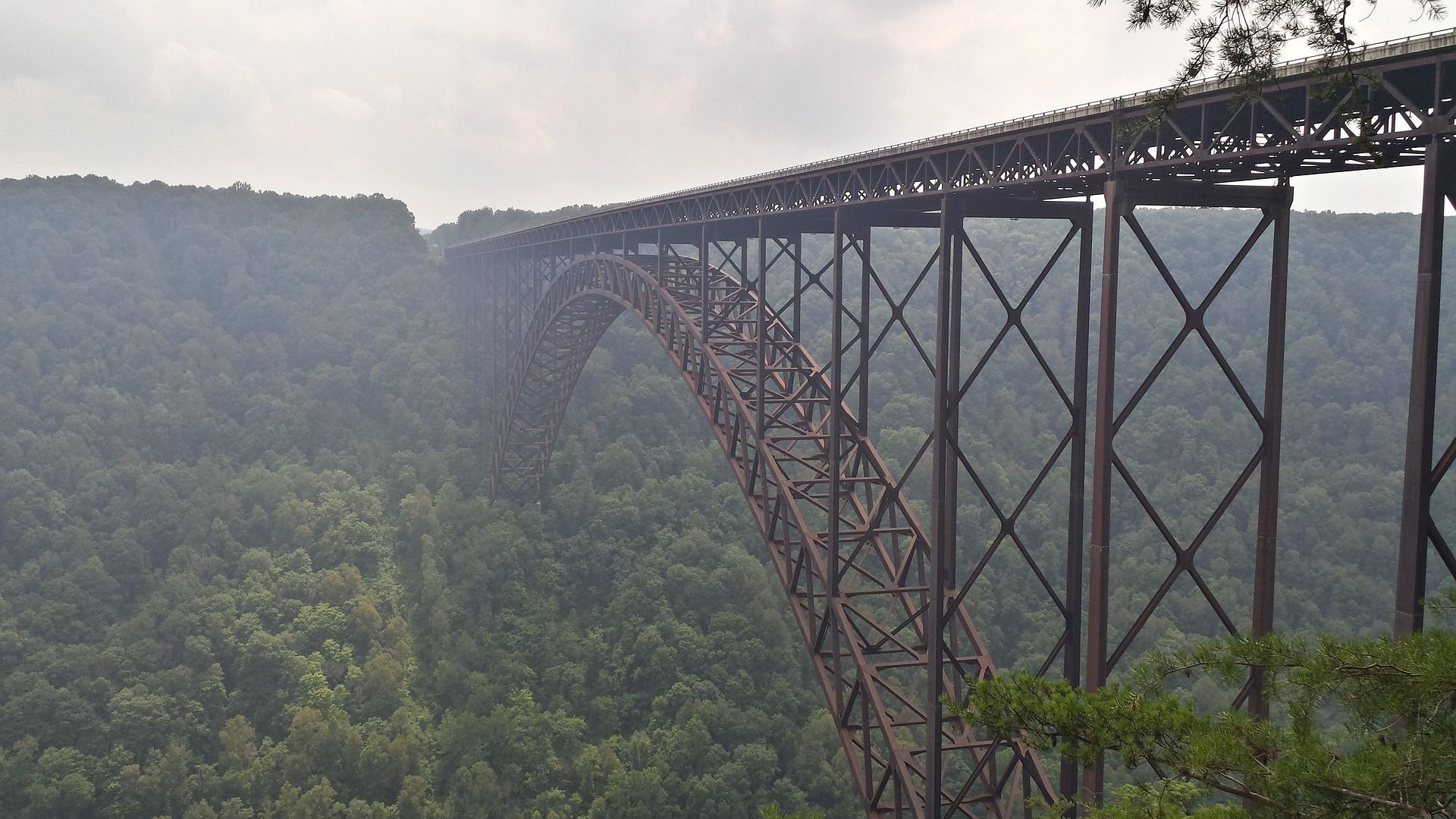
A 3,030-foot steel arch carrying US 19 some 876 feet above the New River — for decades the longest single-span arch bridge in the world, and still the image most people carry of West Virginia. The bridge cut a 40-minute drive down the gorge switchbacks to under a minute. On the third Saturday of October it closes to traffic for Bridge Day, when BASE jumpers legally launch off the catwalk in front of tens of thousands of spectators.
Know before you go
- Canyon Rim Visitor Center has the classic viewing platform and a staircase to a lower deck
- Fayette Station Road drops to the old bridge for the under-the-bridge view
- Bridge Walk guided catwalk tours run year-round, harnessed to a cable
What you can do here
Three vantages do most of the work here: the Canyon Rim Visitor Center platform and the staircase down to its lower deck, Fayette Station Road dropping to the old bridge for the view from underneath, and the catwalk itself on a Bridge Walk tour. The arch spans 3,030 feet and stands 876 feet above the river. On the third Saturday of October it closes to traffic for Bridge Day.
Local organizations
Outdoor Photography across West Virginia →This is an overlook, not a trail system. The walking amounts to the platform and staircase below the Canyon Rim Visitor Center down to a lower deck, which is short and stepped, plus the descent on Fayette Station Road to the old bridge if you want it on foot. Bridge Walk tours cover the catwalk under harness on a cable, not on any trail.
Local organizations
Guides, gear and lodging near New River Gorge Bridge
Place-level placement for operators within range of this trailhead, put-in or crag.
List your business hereNearby in the New River Gorge
Endless Wall Trail
A 2.4-mile point-to-point trail along the gorge rim through hemlock and rhododendron, crossing Fern Creek on a footbridge and reaching Diamond Point, an exposed rock outcrop with a view up the gorge to the bridge.
Long Point Trail
About 3.2 miles round trip on mostly level old roadbed to a rock promontory below the rim, which provides the most-photographed view of the New River Gorge Bridge.
Grandview
1,400 feet above a horseshoe bend in the New, with a seven-mile view up the gorge — the widest perspective anywhere in the park.
Sandstone Falls
The largest waterfall on the New River — not tall, but 1,500 feet wide, spilling across the full breadth of the river between islands at the point where the gorge begins to open.
Kaymoor Miners Trail
A steep descent from the gorge rim to the ruins of the Kaymoor One coal mine and processing plant, including 821 wooden steps down the former haulage incline.
Nuttallburg
An abandoned coal town at the bottom of the gorge with the most complete surviving coal conveyor and tipple complex in the country — a 1,385-foot inclined conveyor running straight up the hillside, once operated by Henry Ford.
West Virginia has roughly 1.5 million acres of public land and a handful of places that carry almost all of the attention. The consequence is that a great deal of very good ground sits nearly empty, usually for one of three reasons: nobody has heard of it, the road in is gated or rough, or it is undeveloped and has nothing to advertise. Those are the places below — of them across regions.